Word Explanation
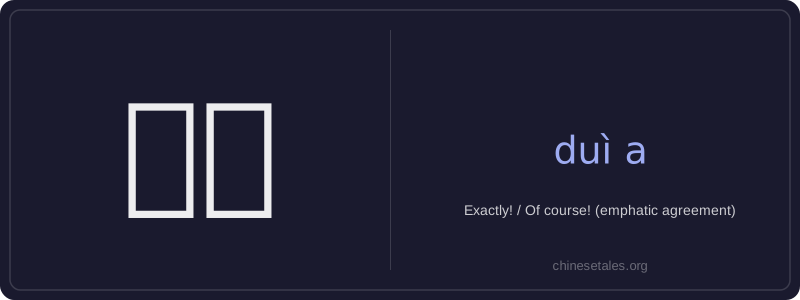
'Duì a' is an interjection expressing emphatic, enthusiastic agreement — equivalent to 'Exactly!', 'Absolutely!', or 'Of course!' in English. The first character 对 (duì) means 'correct' or 'right', and the particle 啊 (a) is a sentence-final modal particle that adds emotional emphasis and softens the tone, making the agreement sound warm and conversational rather than blunt.
This phrase is used almost exclusively in spoken Mandarin, typically as a quick, responsive utterance in informal dialogues — for example, when someone states something obvious, insightful, or previously overlooked, and you instantly recognize its truth. It conveys shared understanding and positive reinforcement, often with a light, friendly, or even slightly surprised tone. It's not used in formal writing or monologues, and never stands alone as a complete sentence without context.
Example Sentences
Related Words
背后
背后 literally means 'back + behind' and functions
见面
见面 literally means 'see face' — combining 见 (t
面条
‘面条’ (miàn tiáo) literally means ‘flour str
我的
我的 (wǒ de) is a possessive pronoun meaning 'my'
中学
'Zhōngxué' literally combines 'zhōng' (middle)
后来
Later (hòulái) is an adverb meaning 'afterwards'
在家
'Zài jiā' literally combines the preposition 'z
不对
不对 (bù duì) literally combines 不 (bù), meani