Word Explanation
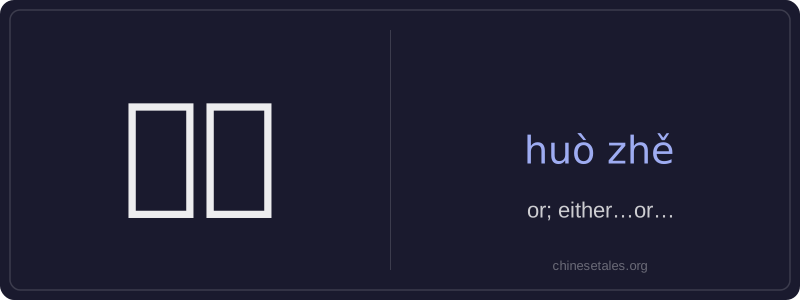
或者 (huò zhě) is a coordinating conjunction meaning 'or'—used to present alternatives or choices between two or more items, actions, or possibilities. The character 或 (huò) originally meant 'perhaps' or 'maybe', carrying a sense of uncertainty or optionality; 者 (zhě) is a classical particle often used to nominalize or mark a person/thing, but here it functions as a grammatical suffix that strengthens the disjunctive force. Together, they form a fixed, modern compound that is neutral in register and widely used in both speech and writing.
This word appears in simple lists (e.g., 'tea 或者 coffee'), conditional structures ('you can stay 或者 leave'), and paired constructions like 'either…or…'—though unlike English, Chinese doesn’t require 'either' before the first item. It’s commonly placed between nouns, verbs, or full clauses, and may introduce more than two options when repeated (e.g., A 或者 B 或者 C). It never appears at the beginning or end of a sentence.
Example Sentences
Related Words
背后
背后 literally means 'back + behind' and functions
中学
'Zhōngxué' literally combines 'zhōng' (middle)
见面
见面 literally means 'see face' — combining 见 (t
面条
‘面条’ (miàn tiáo) literally means ‘flour str
我的
我的 (wǒ de) is a possessive pronoun meaning 'my'
不对
不对 (bù duì) literally combines 不 (bù), meani
后来
Later (hòulái) is an adverb meaning 'afterwards'
在家
'Zài jiā' literally combines the preposition 'z