Word Explanation
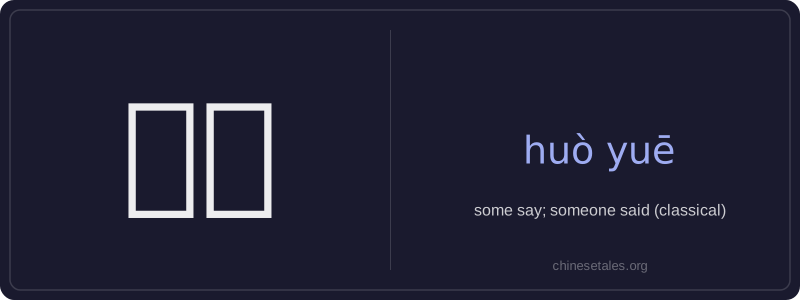
'或曰' is a classical Chinese conjunction meaning 'some say' or 'someone said'. It consists of two characters: '或' (huò), meaning 'some', 'certain', or 'perhaps', and '曰' (yuē), meaning 'to say' or 'said'. Together, they introduce an alternative viewpoint, attribution, or reported speech—commonly found in philosophical texts, historical records, and classical essays. Unlike modern Mandarin expressions like '有人说', '或曰' carries formal, literary, or scholarly register and appears almost exclusively in written classical or semi-classical contexts.
This phrase functions as a discourse marker to signal a shift to an external or contrasting opinion, often preceding a quotation or explanation. It does not refer to a specific person but rather implies anonymous, traditional, or widely circulated views. Learners should recognize it as a fixed classical collocation—not separable or modifiable—and avoid using it in casual speech or modern writing unless deliberately imitating classical style.
Example Sentences
Related Words
背后
背后 literally means 'back + behind' and functions
中学
'Zhōngxué' literally combines 'zhōng' (middle)
见面
见面 literally means 'see face' — combining 见 (t
面条
‘面条’ (miàn tiáo) literally means ‘flour str
我的
我的 (wǒ de) is a possessive pronoun meaning 'my'
不对
不对 (bù duì) literally combines 不 (bù), meani
后来
Later (hòulái) is an adverb meaning 'afterwards'
在家
'Zài jiā' literally combines the preposition 'z