Word Explanation
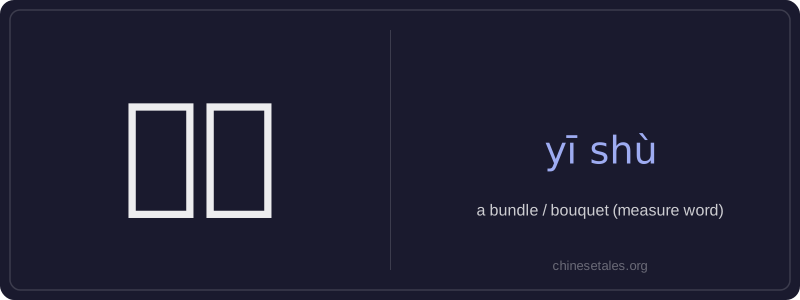
‘一束’ (yī shù) is a measure word phrase meaning ‘a bundle’ or ‘a bouquet’, used primarily for long, slender, or flexible items that can be tied together — most commonly flowers, but also items like wheat stalks, light rays, or even abstract concepts like thoughts. The first character 一 (yī) means ‘one’, and 束 (shù) originally depicted bound sticks and functions as a classifier meaning ‘a bundle tied together’. Together, they form a fixed quantifier structure that must precede the noun it measures.
This phrase emphasizes cohesion and visual unity — it implies the items are gathered intentionally, not just randomly grouped. It’s neutral in register and widely used in both spoken and written Chinese. While 束 can stand alone as a measure word (e.g., 三束花), 一束 is by far the most frequent collocation, especially in gift-giving, poetry, and descriptive writing. It carries a gentle, aesthetic connotation, often evoking care, beauty, or thoughtfulness.
Example Sentences
Related Words
背后
背后 literally means 'back + behind' and functions
不对
不对 (bù duì) literally combines 不 (bù), meani
中学
'Zhōngxué' literally combines 'zhōng' (middle)
见面
见面 literally means 'see face' — combining 见 (t
面条
‘面条’ (miàn tiáo) literally means ‘flour str
我的
我的 (wǒ de) is a possessive pronoun meaning 'my'
后来
Later (hòulái) is an adverb meaning 'afterwards'
在家
'Zài jiā' literally combines the preposition 'z