Word Explanation
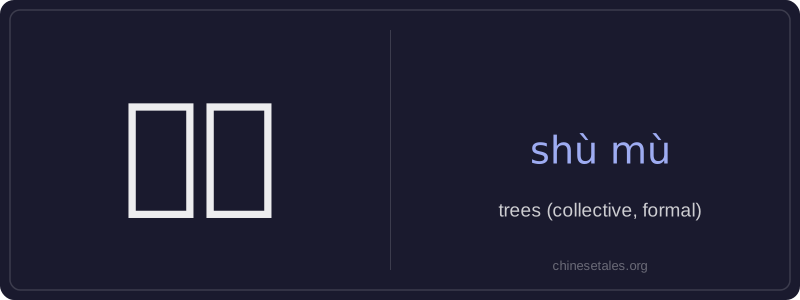
树木 (shù mù) is a formal, collective noun meaning 'trees' — referring to trees as a category or group, not individual trees. The character 树 (shù) means 'tree' on its own, while 木 (mù) means 'wood' or 'tree' in a more general, botanical sense; together, they form a compound that emphasizes the natural, living plant category. This term is commonly used in written Chinese, scientific contexts, environmental discussions, and official documents — for example, when talking about forest conservation, urban greening, or ecological surveys.
Unlike the colloquial word 树 (shù), which can refer to one or more trees depending on context, 树木 always implies plurality and abstraction — you wouldn’t say *一棵树木* (one tree) because it’s inherently collective and uncountable. It often appears with measure words like 类 (lèi, 'type') or 棵 (kē) only when specifying countable instances, but then the phrasing shifts (e.g., 几种树木 'several types of trees').
Example Sentences
Related Words
背后
背后 literally means 'back + behind' and functions
不对
不对 (bù duì) literally combines 不 (bù), meani
中学
'Zhōngxué' literally combines 'zhōng' (middle)
见面
见面 literally means 'see face' — combining 见 (t
面条
‘面条’ (miàn tiáo) literally means ‘flour str
我的
我的 (wǒ de) is a possessive pronoun meaning 'my'
后来
Later (hòulái) is an adverb meaning 'afterwards'
在家
'Zài jiā' literally combines the preposition 'z