Word Explanation
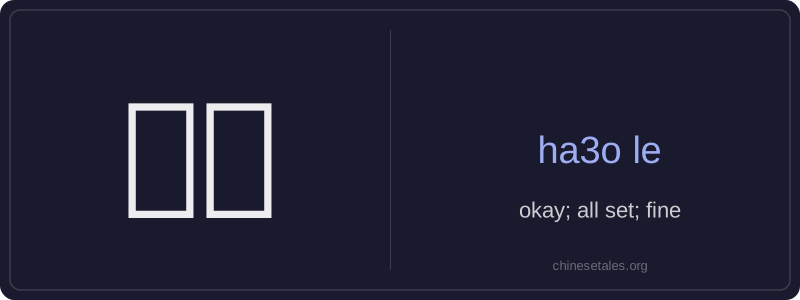
'Hǎo le' is a versatile, commonly used phrase that signals completion, agreement, or acceptance. Literally, 好 (hǎo) means 'good' or 'okay', and 了 (le) is an aspect particle indicating a change of state or completed action. Together, they convey that something has been settled, resolved, or is now acceptable — often with a tone of relief, resignation, or readiness. It functions like English expressions such as 'Okay then', 'All set', or 'Fine, I’ll go along with it'.
This phrase appears frequently in everyday spoken Chinese, especially in casual conversations — for instance, when ending a discussion, accepting a suggestion, confirming a task is done, or gently shutting down further negotiation. While it can stand alone as a response, it may also follow verbs (e.g., 吃好了, 'I’ve finished eating') to indicate completion. Its meaning depends heavily on context and intonation: said brightly, it’s cheerful agreement; said flatly, it may imply impatience or finality.
Example Sentences
Related Words
我的
我的 (wǒ de) is a possessive pronoun meaning 'my'
在家
'Zài jiā' literally combines the preposition 'z
红色的
红色的 (hóng sè de) is an adjective meaning 'red
不对
不对 (bù duì) literally combines 不 (bù), meani
不要
'不要' (bù yào) is a two-character verb phrase m
学校的
'学校的' is a possessive phrase meaning 'school's'
大的
大的 (dà de) is the attributive form of the adjec
你的
你的 (nǐ de) is a possessive pronoun meaning 'you